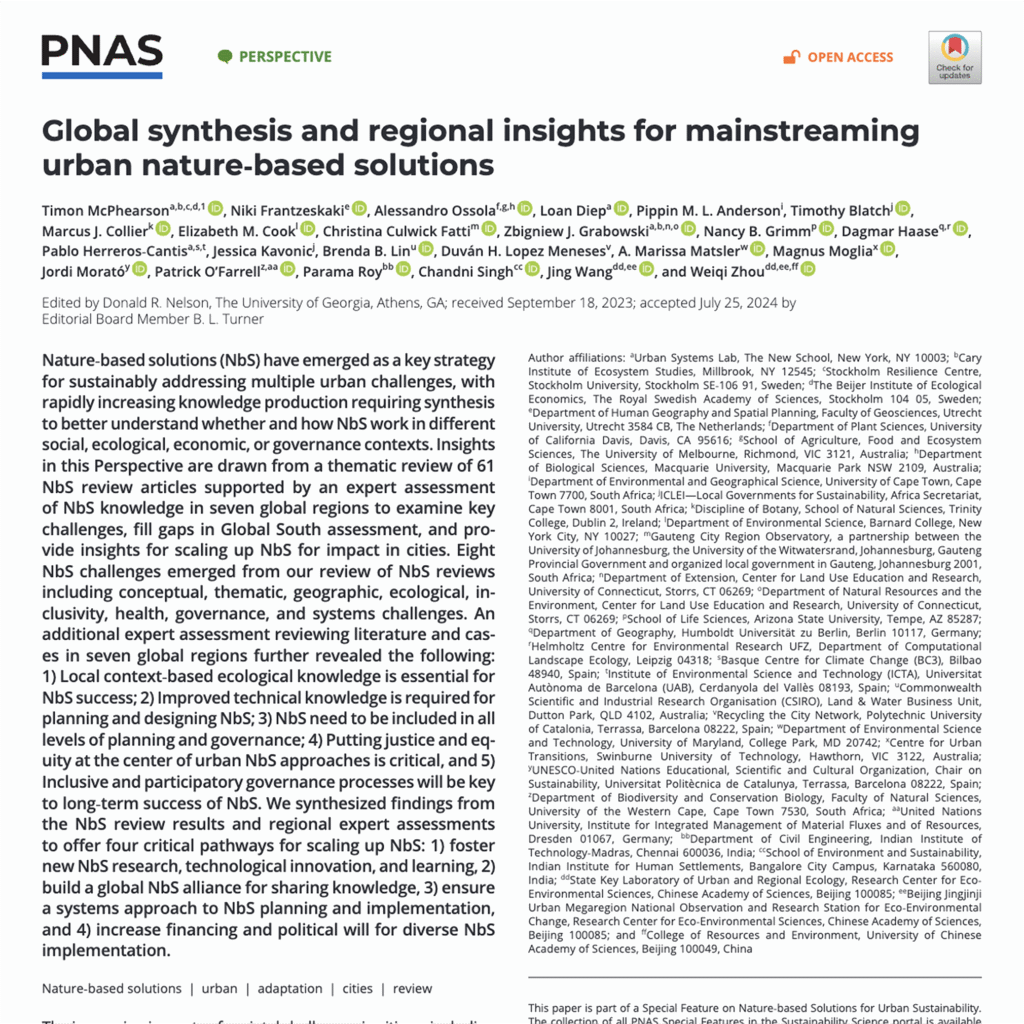
Nature-based solutions (NbS) have emerged as a key strategy for sustainably addressing multiple urban challenges, with rapidly increasing knowledge production requiring synthesis to better understand whether and how NbS work in different social, ecological, economic, or governance contexts. Insights in this Perspective are drawn from a thematic review of 61 NbS review articles supported by an expert assessment of NbS knowledge in seven global regions to examine key challenges, fill gaps in Global South assessment, and provide insights for scaling up NbS for impact in cities. Eight NbS challenges emerged from our review of NbS reviews including conceptual, thematic, geographic, ecological, inclusivity, health, governance, and systems challenges. An additional expert assessment reviewing literature and cases in seven global regions further revealed the following: 1) Local context-based ecological knowledge is essential for NbS success; 2) Improved technical knowledge is required for planning and designing NbS; 3) NbS need to be included in all levels of planning and governance; 4) Putting justice and equity at the center of urban NbS approaches is critical, and 5) Inclusive and participatory governance processes will be key to long-term success of NbS. We synthesized findings from the NbS review results and regional expert assessments to offer four critical pathways for scaling up NbS: 1) foster new NbS research, technological innovation, and learning, 2) build a global NbS alliance for sharing knowledge, 3) ensure a systems approach to NbS planning and implementation, and 4) increase financing and political will for diverse NbS implementation.
As cities worldwide face mounting challenges from climate change, biodiversity loss, health crises, and water insecurity, nature-based solutions (NbS), such as urban forests, green roofs, constructed wetlands, and restored waterways, have emerged as promising strategies for addressing multiple urban problems simultaneously. However, despite rapid growth in NbS research and implementation, knowledge remains unevenly distributed globally, with most evidence concentrated in the Global North and limited understanding of whether and how NbS work effectively in different ecological, social, economic, and governance contexts. This study addresses this critical gap by combining a systematic review of 61 NbS review articles with an expert-driven assessment drawing on regional literature, cases, and expertise from seven global regions including Africa, Asia, Latin America and the Caribbean, to examine key challenges and identify pathways for scaling up NbS implementation worldwide.
The research team identified eight major global challenges facing NbS research and practice: conceptual confusion over what counts as NbS; thematic imbalances with excessive focus on water-related issues while neglecting other climate threats; geographic bias toward Europe and North America; ecological knowledge gaps especially for non-temperate biomes; insufficient attention to justice, equity, and inclusive participation; incomplete understanding of health impacts; fragmented governance approaches; and failure to treat NbS as integrated social-ecological-technological systems. To address Global South knowledge gaps, regional experts across Africa, Asia, Latin America, Europe, North America, Australia, and China provided five critical insights: local ecological knowledge is essential for NbS success; improved technical training and design guidance are urgently needed; NbS must be integrated into comprehensive urban planning rather than isolated projects; justice and equity must be centered in NbS approaches; and inclusive, participatory governance processes are key to long-term effectiveness.
Synthesizing findings from both review processes, the authors propose four essential pathways forward for mainstreaming NbS globally. First, foster innovation by combining indigenous and traditional knowledge with emerging technologies like AI and big data to develop context-appropriate solutions. Second, build a global NbS alliance through networks that facilitate knowledge sharing across regions, disciplines, and practice communities. Third, ensure systems approaches that integrate social, ecological, and technological dimensions throughout NbS planning, implementation, monitoring, and evaluation. Fourth, increase diverse financing mechanisms and political will to support varied NbS types while divesting from carbon-intensive alternatives. The article emphasizes that while NbS hold tremendous potential for transforming cities toward sustainability and resilience, realizing this potential requires addressing persistent geographic, epistemological, and governance inequities while ensuring that solutions developed in the Global North are not inappropriately imposed on contexts with vastly different ecological, social, and institutional realities.
This comprehensive synthesis offers essential guidance for researchers, policymakers, urban planners, community organizations, and practitioners worldwide seeking to harness nature-based solutions for creating more sustainable, resilient, and equitable cities while avoiding the pitfalls of one-size-fits-all approaches.

+27 (0) 21 959 2957
4th Floor, EMS Building
University of the Western Cape
Robert Sobukwe Road
Bellville 7530