
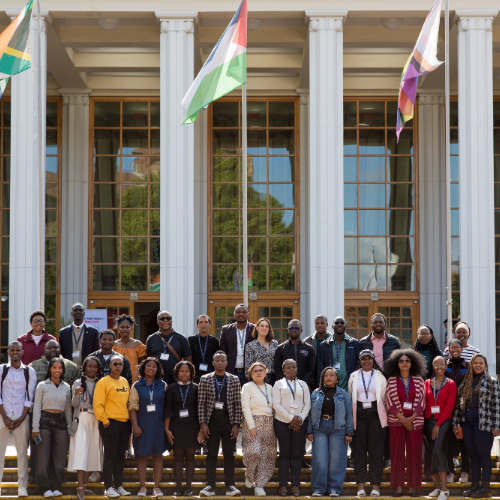
The African Universities Hub for Human Rights (Africa Hub), an initiative housed within the University of the Western Cape’s (UWC) Politics and Urban Governance Research Group (PUG), hosted the Africa Hub Summer School Programme 2025. Held at the University of the Western Cape in Cape Town, South Africa, from 29 September to 03 October 2025, the week-long program convened Human Rights Defenders (HRDs), including civic activists, scholars, journalists, and student activists from across Africa. The school operated under the theme: “Sustainability, Innovation and the Future of Defending Human Rights in Africa”, providing a capacity-building and networking space aimed at enhancing participants’ knowledge and skills to strengthen the human rights protection ecosystem.
The 2025 summer school took place amidst a challenging environment marked by continued threats to HRDs in Africa. HRDs across the continent face arbitrary arrests, judicial harassment, and various forms of persecution. Democratic norms and human rights are being undermined in many parts of Africa, illustrated by examples such as the detention of journalists in Zimbabwe, repression of political activists in countries like Tanzania and Uganda, and persecution following post-election violence in Mozambique. HRDs on university campuses, including scholar activists and student leaders, also face threats as authoritarian regimes tighten control over academic institutions. These challenges are compounded by broader issues like armed conflicts, climate change, and global shifts that have reduced international support, potentially threatening the financial sustainability of protection mechanisms.
In response to this complex landscape, the Africa Hub focused the program on providing the skills and knowledge necessary for HRDs to maintain their effectiveness. The objectives included creating a space for reflection, learning, and networking, enhancing participants’ skills, and exploring methods of collaboration between civil society and universities to advance democracy.
The curriculum was structured around multiple conceptual themes, emphasizing sustainability and innovation. The program utilized workshops and keynotes to cover key areas such as leadership in times of crisis and innovative strategies for securing financial support. Specific training included leveraging digital tools for activism, such as using Artificial Intelligence (AI) in countering disinformation, digital space resource mobilization, and vital lessons in cybersecurity and digital safety.
A critical component of the school was the focus on resilience, well-being, and safety. Workshops dedicated time to stress, trauma, and wellness for HRDs, aiming to build long-term resilience and provide tools for self-care. Additionally, the school employed innovative pedagogical approaches such as storytelling, offering workshops on the use of narrative for healing, solidarity, and advocacy.
UWC, the host institution, aligns the school with its historic commitment to social justice, seeing itself as a sanctuary for critical inquiry. The Africa Hub supports this mission year-round, notably through a three-month non-academic Protective Fellowship launched in 2024, which offers HRDs a safe space for reflection and regeneration. The Summer School served to further expand UWC’s role as a space of protection and solidarity for young African defenders.
